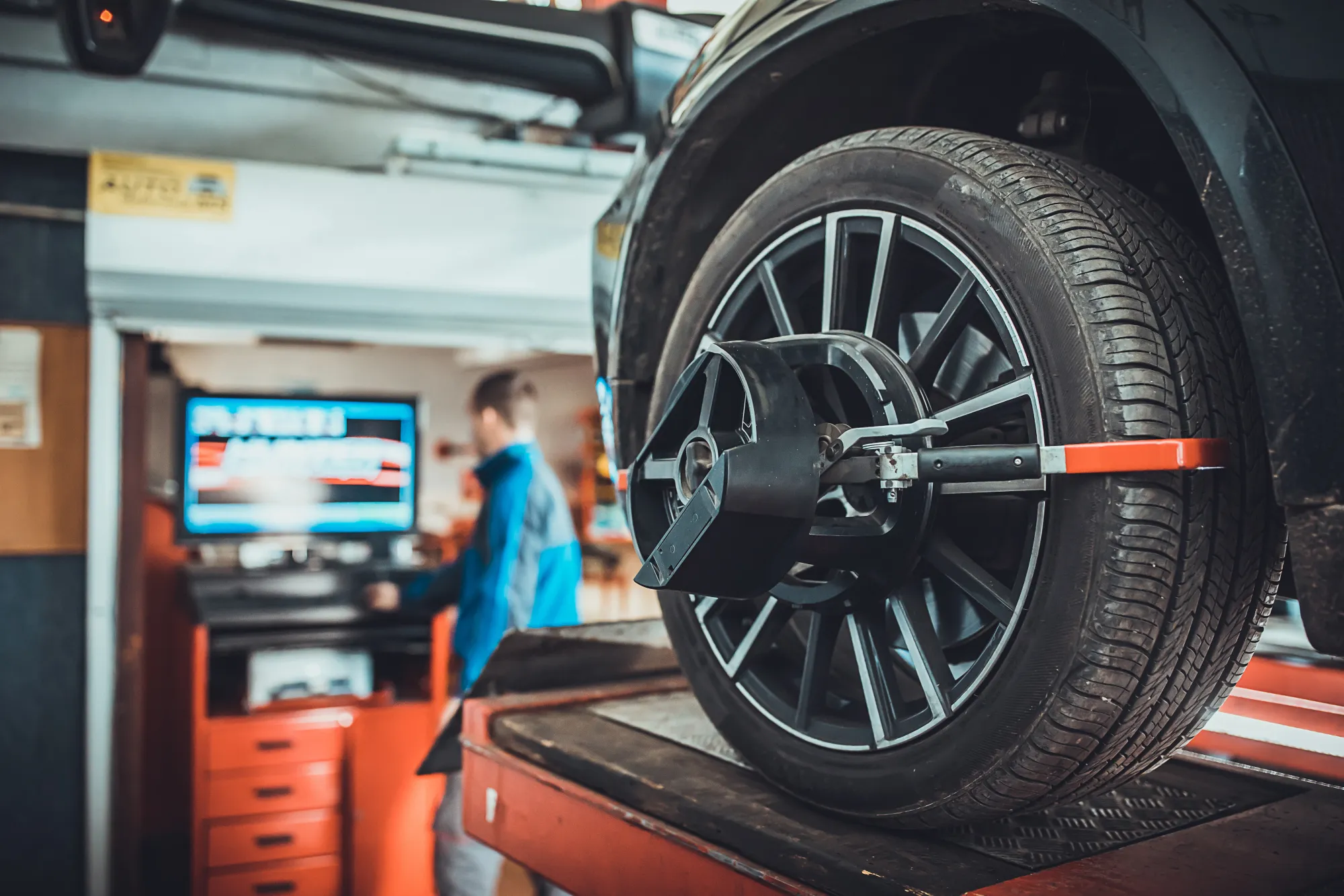
You get an alignment after a rough spring on Champaign County roads. The steering wheel sits straight again, the car tracks true, the printout looks good. Then a week later you are on I-74 toward Bloomington and the lane centering starts nudging you toward the shoulder instead of holding the middle of the lane.
Nothing is wrong with the alignment. The problem is that the camera watching the lane lines never got told the alignment happened.
That is what recalibration is, and it is the step most drivers have never heard of on work they get done all the time. If you have searched for ADAS calibration in Champaign, IL, or wondered whether the shop that did your glass in Bloomington-Normal owed you one, this is the plain-English version. Here is what those sensors watch, what ordinary shop jobs knock them out of aim, and what to ask before you hand over the keys.
What your car is actually watching, and with what
The features on the window sticker (lane keep assist, blind spot monitoring, automatic emergency braking, adaptive cruise) are not one system. They are a handful of separate sensors, each pointed at a different piece of the world.
- A camera behind the windshield, usually up near the mirror, reads lane lines, speed limit signs, and the shape of the vehicle ahead.
- A forward radar, tucked behind the grille or bumper cover, measures distance and closing speed to whatever is in front of you.
- Short-range radar or sonar in the rear corners watches the spaces beside and behind you for blind spot and cross-traffic alerts.
None of this is exotic anymore. Hunter Engineering reports that 96% of 2020 models came with at least one driver-assist function, and more than 60 million vehicles on the road carry these components.
Here is the part that matters. Each sensor is aimed, not just plugged in. Aim is a physical measurement against the vehicle’s geometry, and it can be off by an amount you would never catch by eye. According to AAA, the sensors are calibrated to the car’s thrust line, an imaginary centerline drawn lengthwise through the vehicle, so that what the camera calls “straight ahead” is the direction the car actually travels with the steering wheel centered.
Move the geometry, and the aim is stale.
Why lane keep assist stops working right after an alignment
An alignment is a suspension job. Nobody opens the windshield, nobody unbolts the radar. So why would the camera care?
Because the camera does not work from its own view alone. It cross-checks what it sees against inputs from the rest of the car, including the steering angle sensor. AAA puts it plainly: if the steering angle sensor is adjusted during a wheel alignment, the forward-facing camera that runs lane departure warning may believe the steering wheel is turned. So it “corrects” your steering to get you back between the lines, even though you were already between them.
That is exactly the complaint behind lane keep assist not working after alignment. The car feels like it is arguing with you. It is not broken; it is being obedient to bad information.
Whether a recalibration is required depends on who built your car. Hunter Engineering counted 11 of 28 manufacturers that require a calibration following a wheel alignment, a list that includes Ford, Volkswagen, Jeep, Kia, Dodge, and Subaru. Plenty of other makes do not call for it after a routine alignment. That split is why this cannot be answered with a rule of thumb. It has to be looked up for your specific year, make, and model.
The everyday jobs that put a sensor out of aim
Most people assume recalibration is a collision-repair thing, something that follows a wreck with a tow truck involved. It is not. The manufacturer-listed triggers are ordinary work:
- Windshield replacement, on any vehicle with a camera mounted to the glass.
- Front or rear suspension repair: struts, control arms, springs.
- Steering repair, including a rack or a tie rod.
- A change in ride height, which includes a leveling kit or new springs.
- A change in tire size, even a modest step up in diameter, which is one more thing worth weighing when you are choosing your next set of tires.
- Removal and installation of any driver-assist component, for any reason.
Add the low-speed hit that never becomes a claim. A bump in a campus parking garage pushes a bumper cover in a quarter inch, and the radar behind it is now measuring the wrong stretch of road.
A local version we hear often: a rock off a gravel county road cracks a windshield during harvest, the glass gets swapped on a driveway visit, the camera goes back onto a new bracket, and nobody recalibrates it. A week later the adaptive cruise refuses to set, or the car brakes hard for the shadow under an overpass.
None of these look like a crash. That is precisely why the step gets skipped, and why it is worth asking about at the counter first.
Static versus dynamic recalibration, and why it is not a driveway job
There are two ways to put a sensor back on target, and some vehicles need both.
Static recalibration happens in the shop with the car parked. The vehicle is set square and level, and manufacturer-specified target boards are placed at measured distances and heights in front of it. A scan tool then walks the camera or radar through the procedure and tells it where “straight” is. It needs floor space, a level surface, and controlled lighting, which is exactly why it belongs in a bay and not in your driveway.
Dynamic recalibration happens on the road. The technician drives the vehicle at a specified speed on well-marked pavement while the system watches the lane lines and relearns its aim. Some vehicles are picky about it: crisp markings, no heavy rain, sustained speed. Around here that usually means a stretch of I-74, I-57, or Veterans Parkway rather than a side street in a residential block.
AAA notes that some sensors can be calibrated in the shop, others require the vehicle to be driven under specific conditions, and many must go through both processes. When both are required, the order is set by the manufacturer, so you cannot pick one and call it done.
Why so fussy? This is a small-angle problem with a very long lever. The Auto Glass Safety Council puts it in numbers anyone can picture: one degree of camera error puts the collision avoidance system off by eight feet at 100 feet away. Hunter Engineering makes the same point at highway distance, where a half degree becomes roughly five feet off at 200 yards.
Eight feet at 100 feet is a full lane. That is the difference between a system that sees a car in your path and one that sees a car in the next lane over. AAA is blunt that this work takes manufacturer-specific information, training, tools, and often purpose-built facilities.
How a car tells you its sensors are lying
Sometimes you get a light. AAA notes that out-of-calibration sensors may trigger a warning light or dash message and store a diagnostic trouble code, which is what a scan before and after the work looks for.
Often the car says nothing and just behaves oddly instead. If any of it started within a week or two of glass work, an alignment, suspension work, or new tires in a different size, the repair and the symptom are probably the same story. Watch for:
- Phantom braking for an overpass, a shadow, a crest, or a car clearly in the next lane.
- Lane assist tugging the wrong way, toward the shoulder or the center line rather than the middle.
- Lane centering that will not hold on marked highway where it used to work fine.
- Blind spot alerts on empty road, or alerts that stay quiet when something really is there.
- Adaptive cruise that refuses to engage, or follows at a distance that feels wrong.
- A driver-assist warning message that showed up after a repair and was not there before.
The candid part: nobody, us included, can tell you from a description alone whether your car needs a recalibration. It depends on what your manufacturer requires for that job, and the only way to know is to look it up and scan the car.
Windshield replacement camera recalibration is a parts question first
Windshield replacement camera recalibration in Bloomington, IL and Champaign-Urbana often gets treated as an afterthought to a cheap piece of glass, when the glass itself decides whether calibration is possible at all.
AAA is clear that a replacement windshield not designed for driver-assist use is unacceptable and can prevent proper calibration of the camera. Location pins, mounting brackets, and the black ceramic shade pattern around the edges are part of the manufacturer’s specification, not decoration. Per manufacturer specs, the camera must also be recalibrated any time it is removed from its bracket, which a glass replacement always requires.
Two manufacturer positions from AAA’s research make the point:
- Toyota warns that with aftermarket glass, the black ceramic border may not let the camera see through properly, and the glass may be missing the brackets needed to mount the camera at all. Systems that can be affected include lane departure alert, the forward recognition camera, radar cruise control, the pre-collision system, and automatic high beams.
- Nissan states that the lane camera bracket and cover bracket must not be removed from the glass. They are replaced together with the windshield as an assembly.
So the sequence matters: choose glass that meets the specification, then calibrate. Backwards means paying for a calibration that cannot succeed.
Why this is worth the trouble on Central Illinois roads
Does any of this change outcomes? The Insurance Institute for Highway Safety has measured it. Lane departure warning lowers rates of single-vehicle, sideswipe, and head-on crashes of all severities by 11 percent, and injury crashes of those types by 21 percent. Blind spot detection cuts all lane-change crash rates by 14 percent, and injury lane-change crashes by 23 percent.
Now put that against the roads around here. Federal Highway Administration figures show that in 2016, 18,590 lives were lost on rural roads, more than half of all U.S. traffic deaths, even though only 19 percent of the population lives in rural areas. Two-thirds of those rural deaths involved a roadway departure, meaning a vehicle crossed a center line or edge line or otherwise left its travel lane.
Roadway departure is the exact crash type these systems exist to prevent, and much of the driving around Mahomet, Le Roy, and the county roads between Urbana and Normal is two-lane blacktop with a soft shoulder and a ditch. A camera aimed a degree off out there is a safety feature working from bad information on exactly the roads where lane departure does the most damage.
What to ask any Champaign or Bloomington shop before the work
You do not need to become a technician. You need six questions before any job touching steering, glass, suspension, ride height, or tire size:
- Does my year, make, and model require a driver-assist calibration for this job? Not in general. For this repair, on this vehicle.
- Is it static, dynamic, or both? If both, that is one procedure with two halves, not an upsell.
- Will it be done here or sublet? Either is fine. Knowing which tells you how long the car will be out.
- Will the vehicle be scanned before and after? The before-scan catches codes already there; the after-scan proves the work cleared them.
- Will I get documentation that the calibration completed? The Auto Glass Safety Council recommends getting that commitment in writing before service starts, and confirming the technician is certified for your vehicle.
- What will it come to on my vehicle? That one has no honest answer in an article. It depends on which sensors are involved and what the manufacturer’s procedure requires, so ask us for a current quote on your actual car rather than trusting a number you read online.
Get ADAS calibration in Champaign, IL or Bloomington at Clay Dooley Tire & Auto
Driver-assist features are only as good as their aim, and that aim quietly depends on work you have probably already had done this year. If your car brakes at ghosts, wanders under lane assist, or lights up its blind spot warning at empty pavement, bring it in. Same goes if you have glass, steering, suspension, or tire work coming up. Our Champaign and Bloomington shops can look up what your vehicle calls for, scan it for stored codes, and tell you plainly what it needs, whichever of the two towns you drive in from.
Schedule an appointment at either location, and ask us for a current quote for your vehicle while you are there.