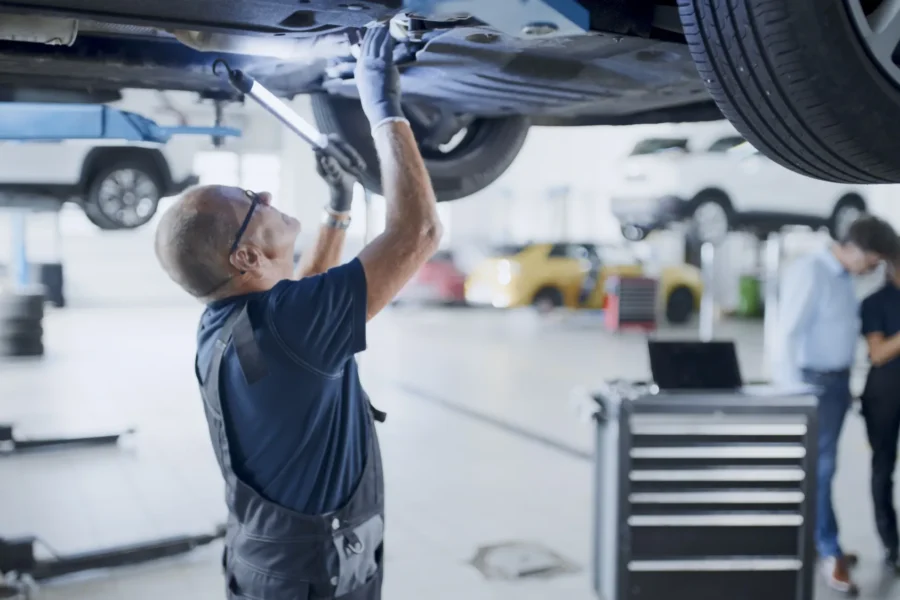
If you moved to Champaign or Bloomington from Missouri, Indiana, or almost anywhere on the East Coast, one of the first pleasant surprises was the paperwork that never came. No annual sticker. No Saturday morning spent in an inspection lane. Nobody with a flashlight telling you your left rear bulb is out.
That surprise is real. Illinois genuinely does not put private passenger cars through a periodic safety inspection, and in this part of the state it does not put them through an emissions test either.
Then you buy a dump truck for the business, or your church picks up a used bus, or the landscaping trailer gets bigger. A very different rule quietly switches on: the Illinois safety test. The vehicle in your driveway is exempt. The vehicle in your shop yard on the edge of Normal is not.
Illinois really does not inspect your personal car
Start with the part everyone gets right. Illinois has no periodic safety inspection program for private passenger cars. No state test measures your brake pads, your tie rod ends, or your tread depth on a schedule, ever.
The state’s only recurring test for passenger vehicles is emissions, and according to the Illinois Environmental Protection Agency it is required only in the Chicago metropolitan area and the eastern suburbs of St. Louis. Most 1996 and newer gasoline vehicles in those areas get tested every two years, starting after the car turns four.
Champaign County and McLean County are in neither area. Your family sedan in Urbana, your commuter crossover in Normal, your gravel-road pickup out past Mahomet: none of them owe the state a thing between renewals.
That is why the second half of this comes as a shock. When drivers hear “Illinois doesn’t inspect vehicles,” they hear a statement about vehicles. It is actually a statement about one class of vehicle.
First division, second division: the line the exemption stops at
Illinois sorts vehicles into two divisions, and the whole thing turns on that split.
First division is what most people drive: passenger cars carrying people. Second division, under the Illinois Vehicle Code, covers vehicles designed to carry more than ten people, vehicles designed or used as living quarters, and vehicles designed for pulling or carrying property, freight, or cargo. It also picks up first division vehicles remodelled for second division work, along with first division vehicles registered as school buses.
For those, the code is direct. Every owner of a second division vehicle, medical transport vehicle, tow truck, driver education vehicle, taxi used for a purpose requiring a school bus driver permit, or contract carrier hauling employees in a vehicle designed for fifteen or fewer passengers must submit that vehicle to a safety test and secure a Certificate of Safety before operating it on Illinois highways.
Read that list again, because it is broader than most people assume. This is not a semi-truck rule. It reaches the church van in Le Roy, the medical transport unit in Champaign, the tow rig working I-74, the driving school car, and the crew truck that carries your employees to the job site.
How to tell whether your work truck is actually covered
Here is what shop customers get wrong most often: coverage is decided by registered gross weight and by how the vehicle is used, not by how the vehicle looks.
A half-ton pickup on a passenger plate never sees an inspection lane. The same body style, registered heavier for business hauling, can land squarely inside the Illinois safety test requirement. The badge on the tailgate has nothing to do with it. The plate class does.
The code exempts second division vehicles registered at or below a light gross-weight threshold, but that exemption has hard exceptions built into it. Tow a trailer above the weight limit and the combination comes back into the requirement. Operate the vehicle as a bus or a tow truck and it comes back in regardless of weight.
That last point catches Bloomington-Normal landscaping and construction outfits regularly. The truck by itself might sit under the line. Hook up the heavy equipment trailer and the answer changes.
Some categories are genuinely out. The code exempts farm tractors, machinery and implements, wagons, wagon-trailers, and similar farm vehicles used primarily in agricultural pursuits, which covers a lot of the equipment moving between fields around Fisher and Gibson City. Recreational vehicles are exempt, and so are vehicles wearing Illinois antique or expanded-use antique plates.
One more program is worth knowing about if you run heavier diesel units. Illinois’ Diesel Emission Inspection Program applies to intrastate diesel vehicles registered above 16,000 pounds that are at least two years old, in specified counties only. It is separate from the safety test, so check whether your county is on that list.
If you are not certain which side of any of these lines a vehicle sits on, do not guess from a forum post. Pull the registration, look at the plate class and registered gross weight, and confirm against the statute or with an Official Testing Station. Guessing wrong is not a paperwork problem. It is a truck sitting still on a Monday morning.
How often the Illinois safety test comes due
The interval depends on the class, and this is where fleet managers lose track.
- Every six months for most second division vehicles, medical transport vehicles, and for-hire units.
- Every twelve months for truck tractors, semitrailers, and property-carrying vehicles registered between 10,001 and 26,000 pounds.
- Every six months or 10,000 miles, whichever comes first, for school buses, which the Illinois Department of Transportation also subjects to more than 5,500 unannounced inspections a year.
The state test itself happens at an Official Testing Station, not at a repair shop. If you are looking for a testing station near you, IDOT regulates inspection criteria at roughly 200 of them across Illinois, with about 260 stations handling truck and trailer work and somewhere around 400,000 vehicle inspections performed statewide each year. Central Illinois is well covered.
Two details about the certificate are worth taping inside a fleet binder. First, the Certificate of Safety expires at midnight on the last day of the month shown by the large number on the sticker, with no grace period. Not the end of that week. Midnight.
Second, the certificate is void if it is removed from the vehicle, and it cannot be reaffixed. That one bites in a way nobody expects. A truck passes in April, catches a rock on I-74 outside Le Roy in July, and gets a new windshield. The sticker leaves with the old glass, and a certificate with months of life left on it is finished. On a vehicle with a windshield the sticker belongs as close as possible to the extreme bottom of the glazing, in line with the steering column on the left side. Vehicles without a windshield carry it on the exterior left side, lower corner, above the bumper rail.
What the Illinois safety test actually examines
The safety test is not a friendly walkaround. It is a defined component list written into the code, and it includes the testing and inspection of:
- Brakes
- Lights, reflectors, and warning flags and flares
- Horns
- Rear vision mirrors
- Mufflers and exhaust
- Safety chains and coupling devices
- Windshields and windshield wipers
- Frame, axle, cab and body
- Wheels
- Steering apparatus
Plus any other safety devices and appliances the code requires. Tow trucks get extra attention on winch mountings, body panels and mounts, and wheel lift swivel points.
Trucks, tractors, trailers, semitrailers, and buses running interstate get held to a stricter yardstick: the Minimum Periodic Inspection Standards promulgated by the federal government. Under the federal periodic inspection rule, every component on that list has to have passed inspection within the preceding twelve months, and carriers have to keep those components at, or promptly repaired to, the minimum standards. A passing inspection under a qualifying state program satisfies the federal annual requirement for twelve months, which is why the paperwork matters as much as the wrench work.
Where trucks actually fail
You do not have to guess which components decide the outcome. The Commercial Vehicle Safety Alliance publishes results from its annual International Roadcheck, and the 2026 numbers are blunt. Across North America, inspectors ran 54,575 commercial vehicle and driver inspections over three days in May and placed 10,350 vehicles out of service, 19 percent of everything they looked at, along with 3,184 drivers.
Those are continent-wide roadside numbers, not Illinois testing-lane numbers, but the pattern travels. Of 13,924 vehicle out-of-service violations, brake systems were the single largest category at 3,379, or 24.3 percent. Tires came second at 2,914. Defective brakes added another 2,072, cargo securement 1,724, and lights 1,659. Add the brake categories together and you get 5,451 out-of-service violations, more than a third of the total.
Brakes and tires. Year after year, that is the answer.
The encouraging half of the same report: 81 percent of inspected vehicles had no out-of-service violations at all, and inspectors handed out 17,680 decals to vehicles that passed a comprehensive inspection. Trucks that get maintained pass. Trucks that get hoped over do not.
Prepping for a work truck inspection in Bloomington IL or Champaign
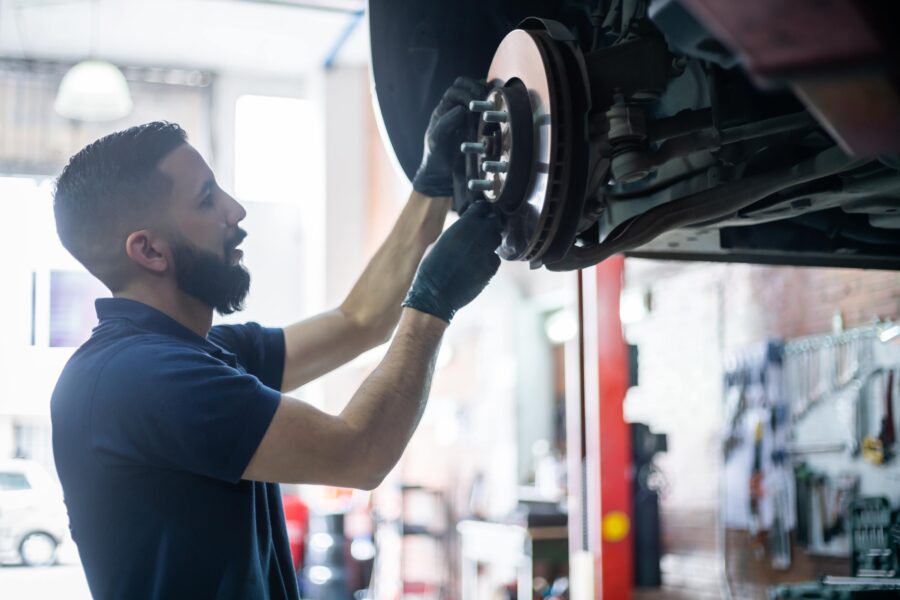
If brakes, tires, lights, and steering decide most failures, then getting ready for a work truck inspection in Bloomington IL is not mysterious. It is the same component list, worked through before the truck goes to the lane instead of after it gets rejected.
A useful pre-test routine looks like this:
- Measure, do not eyeball, the brakes. Lining thickness, drum and rotor condition, air system performance, pushrod travel where it applies. A brake job discovered in the lane is a truck out of service; the same brake job discovered two weeks early is a scheduled visit. If you are not sure how much life is left, our post on how long brake pads last covers what actually drives wear, and our brake service page covers what we check.
- Look hard at tires. Tread depth across the whole width, sidewall damage, mismatched sizes on an axle, and the slow leaks that township gravel roads around Fisher and Le Roy hand out every harvest. If a unit is due for replacement, the factors worth considering when choosing tires apply to work trucks even more than to cars.
- Walk every lamp and reflector. Marker lights, trailer connections, corroded grounds. This is the quickest category to fix and one of the most common to fail.
- Check steering and the front end. Free play, tie rods, kingpins, and the alignment that Champaign County potholes quietly destroy. The same signs you need a wheel alignment show up on a loaded truck, just louder.
- Inspect exhaust, frame, and mounts. Muffler condition, leaks into the cab, cracked crossmembers, worn body mounts.
- Do not forget coupling gear. Pintle hooks, fifth wheels, safety chains, and the pins nobody looks at until something drags.
Timing matters as much as the work. Book the pre-test inspection with enough runway that parts can be ordered and installed before the sticker month closes, not during the week it expires. Harvest is the worst time to find out a truck needs steering work, and harvest is exactly when most of ours show up needing it.
Fleet vehicle services in Champaign and Bloomington
We have been fixing trucks in central Illinois since 1917, and the fleets we work with in Champaign, Urbana, Bloomington, and Normal tend to settle into the same rhythm: maintenance intervals timed to the safety test cycle, one shop handling brakes, tires, steering, and exhaust for the whole yard, and one phone number to call when a unit needs to be back on the road tomorrow.
That is what our fleet vehicle services in Champaign and Bloomington are built around. We do the inspection and repair side; you take the truck to the Official Testing Station with nothing left to find. Records stay organized, downtime stays predictable, and nobody discovers a brake problem in a testing lane with a crew waiting on a job site.
Every fleet is shaped differently, so a service program for six trucks is not the same as one for twenty. Give us the vehicle list and how each unit is registered, and we will put together a current quote for what your fleet actually needs.
Illinois will never ask about your car. It will absolutely ask about your work truck. Schedule an appointment at our Champaign shop or our Bloomington shop and get your answer before the state does.