Every Central Illinois driver knows the sound. You’re heading down a familiar stretch of road in early spring, the pavement chewed up by another winter of freeze and thaw, and bang, you drop a front wheel into a pothole deep enough to swallow a coffee cup. You wince, keep driving, and forget about it by the next block. But your car may not have forgotten. A hit like that is one of the most common ways a vehicle’s wheels get knocked out of alignment, and around here, we get a lot of them.
By the time the potholes bloom every March, the roads around Champaign, Bloomington, and the surrounding towns have taken a beating, and so have the cars driving on them. The frustrating part about alignment problems is that they rarely announce themselves with a warning light. Instead, they show up as small annoyances that quietly cost you money: chewing through a set of tires months early, dragging down your fuel economy, and making your car just a little less safe to drive.
The good news is that your car does give you signals. Here are the five clearest signs you need a wheel alignment, what alignment actually is, and why catching it early is one of the cheapest ways to protect your tires and your safety.
First, What Is a Wheel Alignment, Really?
“Alignment” doesn’t mean straightening your wheels like you’d straighten a crooked picture frame. It refers to adjusting the angles at which your tires meet the road, so all four are pointed exactly where the manufacturer intended. Technicians talk about three main angles:
- Camber: how much the tire tilts inward or outward when viewed from the front. Too much either way wears one edge of the tire.
- Toe: whether the tires point slightly inward or outward, like being pigeon-toed or duck-footed. This is the biggest culprit in rapid tire wear.
- Caster: the angle of your steering axis, which affects straight-line stability and steering feel.
These angles are set to fractions of a degree, which is why it doesn’t take much to knock them off. A hard pothole hit, a bumped curb while parallel parking downtown, or thousands of miles of ordinary wear on worn suspension parts can all pull them out of spec. A proper alignment puts them back, and it takes precision equipment to measure and set them correctly.
Sign #1: Your Car Pulls to One Side
This is the classic tell. You’re driving on a straight, level road, and you notice you have to keep a little steady pressure on the wheel to keep going straight, because the car drifts left or right on its own if you relax your grip.
A pull almost always means your alignment is off, though it can occasionally point to uneven tire pressure or a tire problem. Either way, it’s worth checking. Beyond being annoying on a long highway drive, a persistent pull means you’re fighting your own car all day, and it’s a sign the tires aren’t rolling the way they should.
Quick self-check: On an empty, straight stretch with no crown in the road, briefly loosen your grip (don’t let go) and see if the car wanders consistently to one side. If it does, get it looked at.
Sign #2: Uneven or Rapid Tire Wear
Your tires are a running scorecard of your alignment. When the angles are off, the tread wears unevenly, and unevenly-worn tires are one of the most expensive consequences of ignoring an alignment.
Walk around your car and look closely at the tread. Warning patterns include:
- One edge worn far more than the other (often a camber issue)
- Feathering: tread that feels smooth when you run your hand one way and sharp the other (usually toe)
- Patches or scalloped cups around the tire
A set of four decent tires is a real investment, and a bad alignment can shave months or even years off their life. If you’re shopping for new tires, it’s also worth understanding what actually matters when you’re choosing them, because putting a fresh set on a misaligned car is like pouring money straight onto the pavement.
Sign #3: Your Steering Wheel Is Crooked When Driving Straight
Here’s an easy one to spot. When you’re driving down a straight road, your steering wheel’s logo should sit level and centered. If you’re rolling straight but the wheel is cocked off to one side (say, the emblem tilts to 10 o’clock), your alignment is off.
Drivers get so used to this that they stop noticing it, unconsciously holding the wheel a little crooked all the time. But it’s a clear, visible symptom that your wheels aren’t pointed where the steering wheel thinks they are. After a proper alignment, that wheel should come back to center.
Sign #4: Vibration or a “Loose” Feeling in the Steering
If your steering wheel shakes or vibrates, alignment may be part of the story, especially if a pothole hit is what kicked it off. Vibration can come from several sources (tires that need balancing, a bent wheel, worn suspension components), and alignment issues can accompany or worsen the sensation.
Because vibration has more than one possible cause, this is one where a professional look pays off. The same pothole that knocks your alignment out can also bend a wheel or damage a suspension part, and those problems travel together. A technician can tell you whether you’re dealing with a simple alignment, a balance issue, or something in the suspension that needs attention.
Sign #5: Squealing Tires or Noise in Turns
When your tires are scrubbing against the pavement at the wrong angle instead of rolling cleanly, they can squeal, particularly on turns or at low speeds. It’s the sound of rubber being dragged sideways, and it means wasted tire life with every mile.
Not all tire noise is alignment-related, but combined with any of the signs above, squealing is another nudge to get your alignment checked before that scrubbing eats through your tread.
Alignment, Balancing, and Rotation: What’s the Difference?
These three services get lumped together, but they solve different problems, and knowing which is which helps you spend your money wisely:
- Alignment corrects the angles of your wheels so the tires point where they should. It’s what fixes pulling and angle-related uneven wear.
- Balancing corrects tiny weight imbalances in a tire-and-wheel assembly by adding small weights, which cures the high-speed vibration you feel in the steering wheel or seat.
- Rotation simply moves tires from one position to another so they wear evenly over their life.
A pothole hit can trigger the need for all three at once, which is exactly why a single professional inspection beats guessing at which one you need.
Why Central Illinois Is So Hard on Alignment
It’s not your imagination: our region is genuinely tough on alignment, and it comes down to a few local realities:
- Freeze-thaw potholes. Central Illinois winters cycle above and below freezing constantly. Water seeps into cracks, freezes, expands, and tears the pavement apart, creating the crater field that greets us every spring.
- Railroad crossings. With rail lines running through Champaign, Bloomington-Normal, and the smaller towns between, drivers hit a lot of rough crossings that jolt the suspension.
- Gravel shoulders and rural roads. Out in the county, uneven surfaces and hidden ruts add up over time.
- Seasonal temperature swings. Constant expansion and contraction keeps our roads rougher than in milder climates.
All of that means Central Illinois drivers should think about alignment more often than the “average” recommendation suggests, especially after a hard winter or a memorable pothole hit. If you’ve been typing “wheel alignment near me” into your phone after a rough drive across town, you’re not alone; it’s one of the most common spring service calls we get.
What Actually Happens During an Alignment
If you’ve never had one done, the process is straightforward and worth understanding, because it explains why alignment is worth doing right:
- Inspection first. Before touching the angles, a technician checks your tires, steering, and suspension components. There’s no point aligning a car with a worn tie rod or ball joint: those parts have to be sound first, or the alignment won’t hold.
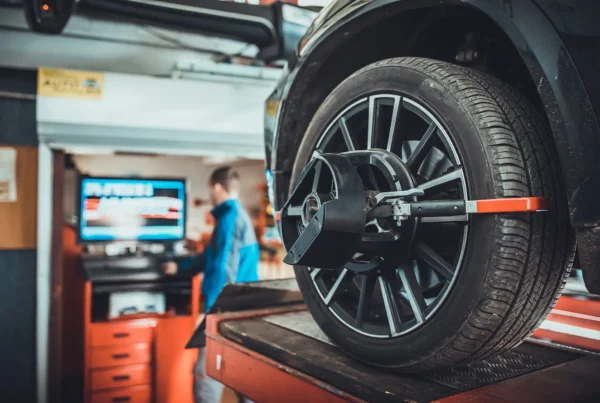
- The car goes on an alignment rack. Sensors or cameras clamp to each wheel and feed exact angle readings into a computer, compared against your vehicle’s factory specifications.
- Adjustments are made. The technician adjusts camber, toe, and caster back into spec using the vehicle’s built-in adjustment points.
- A before-and-after readout. A good shop shows you the numbers: where your angles started (in the red) and where they ended (in the green), so you can see exactly what was corrected.
Most alignments take under an hour, and the payoff is measured in months of extra tire life and a car that drives the way it should.
How Often Should You Get an Alignment Checked?
There’s no single mileage rule, but good guidelines are:
- Once a year, or every 10,000–12,000 miles, as routine maintenance.
- Whenever you buy new tires, to protect that investment from day one.
- After any hard impact: a deep pothole, a curb strike, or a rough railroad crossing that made you cringe.
- Anytime you notice one of the five signs above.
An alignment check is quick and inexpensive compared to a new set of tires or a suspension repair. Think of it the same way you’d think about staying on top of your brakes, a small, regular check that prevents a much bigger bill.
Protect Your Tires: Get a Wheel Alignment in Champaign or Bloomington
Your tires are the only four patches of rubber connecting you to the road, and alignment is what keeps them wearing evenly, gripping properly, and lasting as long as they should. Ignoring it doesn’t just cost you tires; it quietly costs you fuel economy and a measure of safety every day you drive.
If your car is pulling, your steering wheel sits crooked, or you’ve noticed uneven tread after this year’s pothole gauntlet, don’t wait for it to get worse. Our technicians use precision equipment for every wheel alignment in Champaign, IL and wheel alignment in Bloomington, IL, and we’ll show you exactly what your angles are doing before and after: no guesswork, no upsell.
Schedule an appointment at Clay Dooley Tire & Auto today, and let’s get your car tracking straight and your tires lasting the way they should through every Central Illinois season.