You know the drive. A little after six on an October morning, sun not up yet, a combine working the field on your right with its lights on. You come up behind a grain truck, back off, and follow it a mile and a half with your windows rolled all the way up. By the time you reach the blacktop you can still taste the chaff, and there is a fine tan film on the hood that was not there when you left the driveway in Mahomet, or Le Roy, or Fisher.
That film is the visible part. The part you cannot see went straight into two filters your car depends on and most drivers never think about. One protects your engine. The other protects you. They are not the same part, they do not do the same job, and neither covers for the other.
Across Champaign-Urbana, Bloomington-Normal, and every township road in between, fall is the dustiest stretch of the driving year. Of all the car maintenance central Illinois drivers could tackle before winter, this pair of filters is the one that pays off soonest.
Why Fall Is the Dustiest Six Weeks of the Driving Year Around Champaign and Bloomington
This is not a vague seasonal feeling. It is on a calendar, and the USDA National Agricultural Statistics Service publishes it. In Illinois, corn for grain harvest usually begins around September 14, runs most actively from September 23 through November 5, and wraps up near November 20. Soybeans usually begin around September 19, run most actively from September 26 through October 26, and finish near November 7. Illinois Farm Families describes the same rhythm from the field side, placing soybean harvest in late September and October.
Overlap those windows and you get roughly six weeks where nearly every rural road in Champaign and McLean counties carries combines, grain carts, and loaded semis. Field entrances go muddy, then dry, then powder. Township gravel grinds finer with every pass. And every car driving past it is pulling that air through itself.
Then there is pollen stacked on top of the dust. According to the Asthma and Allergy Foundation of America, ragweed season starts around August, can last six to 10 weeks, peaks in mid-September across most of the country, and can run through October. A single ragweed plant can put out roughly a billion pollen grains. Same window as harvest, same air, same commute.
Two Filters, Two Completely Different Jobs
The simplest way to keep them straight:
- The engine air filter sits in a plastic housing under the hood, usually a black box beside the engine with a large duct running out of it. Every bit of air your engine burns comes through it first. Its job is keeping grit out of the intake, out of the cylinders, and off the sensors downstream.
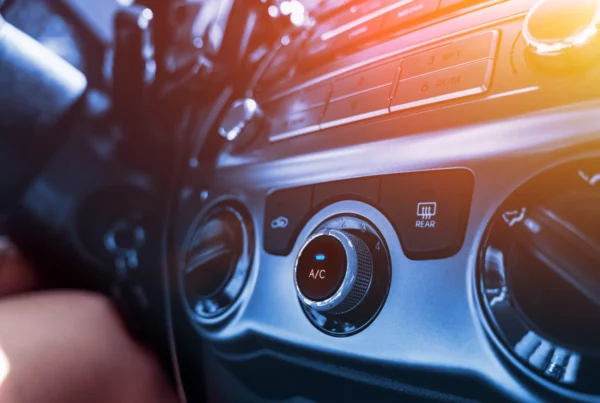
- The cabin air filter is a flat panel, most often behind the glove box, sometimes under the dash or at the base of the windshield. Every bit of air that comes out of your vents comes through it first. Its job is keeping dust, pollen, soot, and road grime out of the space where you and your passengers sit.
Same word, two jobs, two locations, and two separate line items in your owner’s manual. A shop that changes one has not touched the other. Worth asking about directly the next time somebody hands you a service list.
It helps to appreciate how much work the cabin filter does. MANN-FILTER, a major filter manufacturer, notes that air moves into a vehicle through the ventilation ducts at up to 540,000 liters per hour, that in-vehicle air can carry roughly five times more exhaust gases, pollutants, and allergens than outside air, and that a good cabin filter captures up to 90 percent of particulates down to about a micron. All inside a part the size of a hardback book.
What a Clogged Engine Air Filter Actually Does to How Your Car Drives
There is an old piece of advice that a fresh engine air filter improves your gas mileage. On modern vehicles that is not accurate, and it is worth clearing up, because it sends people hunting for the wrong symptom.
The U.S. Department of Energy is direct about it on fueleconomy.gov: replacing a clogged air filter on a vehicle with a fuel-injected, computer-controlled gasoline engine does not improve fuel economy. What it can improve is acceleration. Your engine computer measures incoming air and matches fuel to it, so when the filter restricts airflow, the computer trims fuel to match. You do not burn more gas. You just get less air, and less power.
So the symptom to watch is throttle response, not the gas gauge.
That is why the clearest complaint we hear is a pickup that merges onto I-74, asks for everything above 50 miles an hour, and feels flat and breathless doing it. Nothing grinding, no light on, it just will not pull the way it used to. Fresh filter, and it drives like itself again. That is exactly the acceleration effect the DOE describes.
The second reason to care is protection, not performance. That filter is the only thing between harvest dust and the inside of your engine, and grit that gets past it does not come back out.
The engine air filter replacement Bloomington IL drivers keep putting off is rarely worth a trip on its own. It is a fast item on a routine visit, and one our technicians look at anyway during a general inspection.
What a Clogged Cabin Air Filter Does to How Your Car Feels
The cabin filter announces itself differently. It does not change how the car drives at all. It changes how the car smells and how it breathes.
Toyota puts the two symptoms right in its scheduled maintenance guide, and the wording is worth borrowing because it comes straight from the manufacturer: replacement may be needed if you notice reduced air flow from the air conditioner and heater, or if the windows fog easily when you use the Fresh mode.
Read that second one again, because it is the one that matters in November. A defroster does not clear a windshield with heat alone. It clears it by pushing a large volume of dry air across the glass. Choke the volume and the glass takes far longer. That is the difference between backing out of the driveway on a damp morning and sitting in it with the fan roaring, wiping the inside of the glass with your sleeve so you can see well enough to leave.
The other three signs drivers describe:
- Weak vents on high fan. You can hear the blower working hard, but very little air arrives.
- A musty, damp-basement smell whenever the fan comes on, especially once AC season ends and a filter full of damp chaff and pollen sits in a cold duct.
- Allergy symptoms worse inside the car than outside it, which tracks with how concentrated in-vehicle air can be.
When they go looking for a cabin air filter, Champaign IL drivers usually turn up with one of those four complaints and no idea which part causes it. That is normal. It is a hidden part with very obvious effects.
If your vents are weak and the AC has also been underwhelming, those can be two separate stories. Our post on why your car’s AC blows warm air sorts out which is which.
How to Tell Which One Is Due
You can sort most of this out in your own driveway in about a minute. Two questions, in order.
- Did something change about how the car drives? Sluggish acceleration, a breathless feeling merging or climbing, less pull when you ask for passing power. That points at the engine air filter.
- Did something change about how the car smells or breathes? Weak vents, musty odor, a windshield that fogs and will not clear, worse allergies inside the car than out. That points at the cabin air filter.
If both answers are yes, that is not two unrelated failures. It usually means the vehicle has been living in dust and both filters have been loading up on the same commute at the same time.
Two notes on doing this yourself. Holding an engine air filter up to a shop light and calling it clean is a rougher test than people think: it can look tan and still flow fine, or look acceptable and be packed solid down in the pleats. And many cabin filters sit behind a glove box that has to come apart in a particular order, worth watching someone do once first.
At either of our shops, our ASE-certified technicians pull both filters, look at them in good light, and tell you what they actually see. For what the work runs on your specific vehicle, request a current quote rather than guessing from a number you read somewhere.
Why a Gravel Commute Beats the Sticker on Your Windshield
Here is the part that catches careful owners off guard. You are following the schedule, and the schedule is still wrong for you, because it counts miles and has no idea what road you drove them on.
Look at how a manufacturer handles it. On the normal schedule in Toyota’s maintenance guide, the engine air filter and the cabin air filter are both 30,000-mile or 36-month replacement items. But the same guide carries a section called Additional Maintenance Items for Special Operating Conditions, and one of those conditions is driving on dirt roads or dusty roads. Under that heading, “Inspect engine air filter” shows up as early as the 5,000-mile or 6-month service, and again at every service after it.
That is the manufacturer telling on itself. The 30,000-mile number assumes clean pavement. Drive gravel and field roads and the same manual wants eyes on that filter six times sooner.
The cabin filter gets the same treatment. Toyota’s guide says to replace it at the specified intervals, then adds that driving in heavy traffic, on dirt roads, or in urban, desert, or dusty areas may shorten the filter’s life and that more frequent replacement may be necessary. MANN-FILTER suggests replacing a cabin filter at least once a year regardless of mileage. Premium Guard, another filter maker, frames the engine side simply: around 30,000 miles in normal conditions, twice as often in extreme ones.
Now put your own commute against that. Two miles of township gravel out to Route 150, twice a day, through the six weeks the USDA calls the most active harvest window. You are not an edge case. You are the severe-service example the manual was written for, and so is anybody running a rural route out of Bloomington-Normal. Fleet owners feel it hardest: every van hits the dusty-road exception, and no two hit it on the same odometer reading.
It is the same logic behind how often you should really change your oil around here. Conditions set the interval. The sticker is only a starting point.
Car Maintenance Central Illinois Drivers Should Handle Before Winter
There is a reason to do this in the fall specifically, and not whenever.
In July, a weak vent is a comfort problem. In December it is a visibility problem. Frost outside, fog inside, a short winter morning, and a defroster that cannot move enough air is a real safety issue, and one of the simplest to rule out. Do it before the first hard freeze, not after.
Both filters are quick to check, and checking them fits into a visit you are probably already planning. If a general service is on your list anyway, our modern tune-up covers the ground where both of these live, and while the vehicle is up it is a good moment to look at whatever else harvest season has been hard on.
Clay Dooley Tire & Auto has been looking after central Illinois vehicles since 1917, so we have watched a lot of harvests roll through and know what they leave behind in a filter. Bring yours to our Champaign or Bloomington shop, let our ASE-certified technicians pull both filters and show you what came out of the air, and request a quote for whatever it turns out you need. Your engine breathes better, your windshield clears faster, and you get through the fall without wondering what that tan film on the hood was doing to your car.