It’s the middle of July, you’re stuck at a light on Prospect Avenue with the sun cooking the dashboard, and you reach over to crank the AC. Instead of that first blast of cold relief, you get a lungful of lukewarm air that somehow feels worse than rolling the windows down. If you’ve lived through a Champaign or Bloomington summer, you know that a car’s air conditioning isn’t a luxury here: between the heat and the Central Illinois humidity, it’s the difference between an easy commute and a miserable one.
The good news: car AC blowing warm air is one of the more understandable problems your vehicle can have. There are really only a handful of causes, and once you know what they are, you can usually tell whether you’re looking at a quick fix or a real repair. This guide walks through each culprit, what’s safe to check yourself, and when it’s time to let a technician put a gauge on the system.
The short version: your AC blows warm for five main reasons: low refrigerant (almost always from a leak), a failing compressor, a clogged condenser, a dirty cabin air filter, or an electrical fault. You can safely check the filter, your settings, and the fuse. Anything involving refrigerant needs professional tools. Here’s how to figure out which one you’re dealing with.
First, How Your Car’s AC Actually Works
You don’t need to be a mechanic to troubleshoot your AC, but one idea makes everything click: your air conditioner doesn’t make cold air; it removes heat from the air that’s already in your cabin.
It does this by cycling a refrigerant through a sealed loop. The key parts are:
- The compressor: the pump that pressurizes the refrigerant and keeps it moving. Think of it as the heart of the system.
- The condenser: a radiator-like grille at the front of the car that dumps absorbed heat into the outside air.
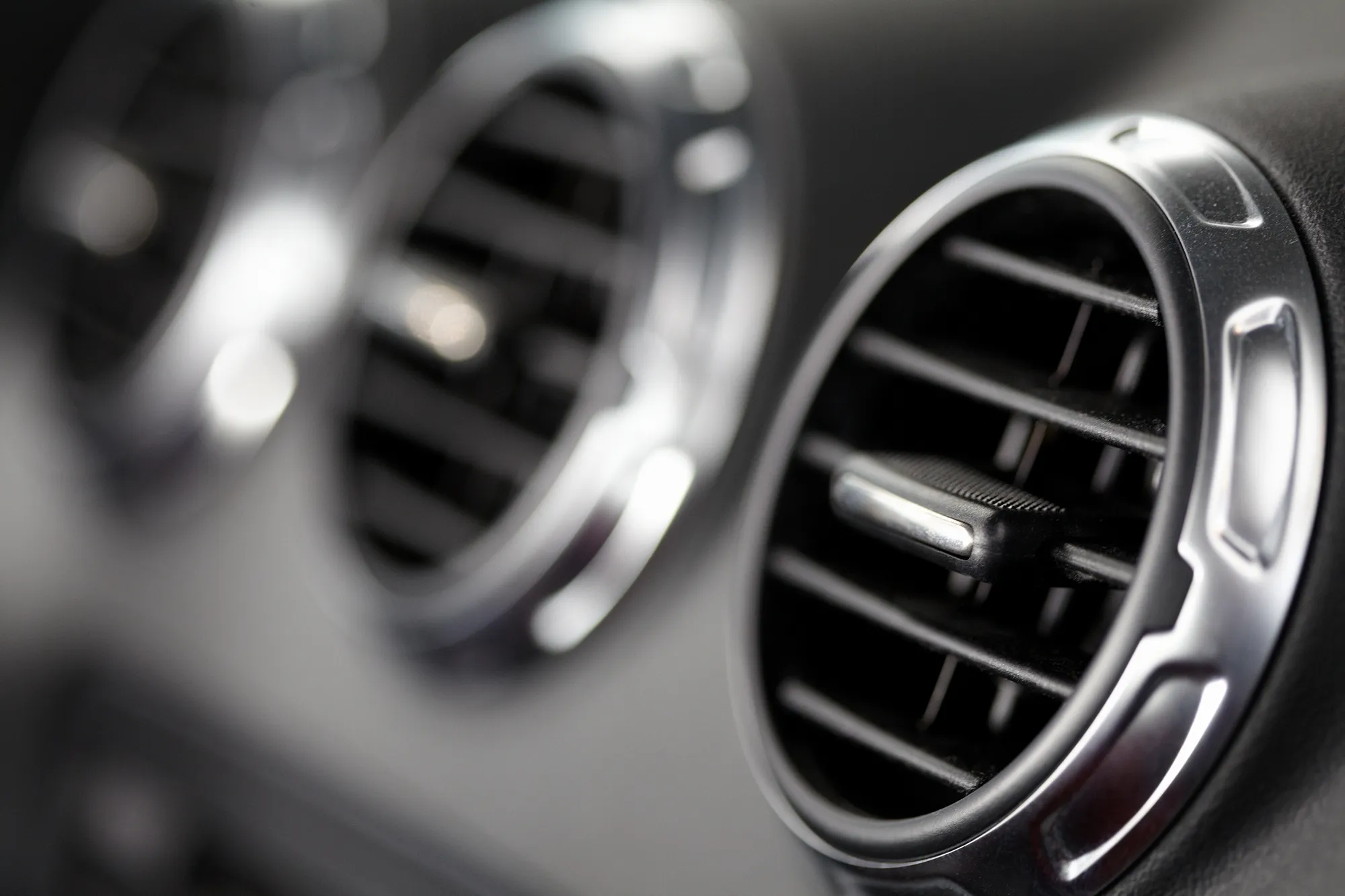
- The evaporator: tucked behind your dashboard, where the refrigerant pulls heat out of the cabin and cold air gets blown toward you.
- The refrigerant: the fluid that carries heat around the loop. Modern cars use R-134a or, in newer vehicles, R-1234yf.
When any single link in that chain breaks, the whole thing stops cooling, and you get warm air out of the vents. Here are the usual suspects, roughly in the order we see them at our Champaign and Bloomington shops.
1. Low Refrigerant (the Most Common Cause)
If your AC used to be ice-cold and has slowly faded over a season or two, low refrigerant is the likeliest reason. Your system is sealed, so in a perfect world it never needs a “refill.” That means when refrigerant is low, there’s almost always a leak: at a hose, a seal, a fitting, or a component like the condenser.
This is the single most important thing to understand about car AC: low refrigerant is a symptom, not the disease. A quick top-off might get you cold air for a few days or weeks, but if there’s a leak, that refrigerant will escape again. A proper repair finds the leak first, fixes it, and then recharges the system to the correct level. That’s why a cheap can of “AC in a can” from the parts store so often disappoints: it masks the problem instead of solving it, and some sealant products can actually damage the system.
What you might notice:
- Air that’s cooler than outside but never truly cold
- AC that works okay in the morning but fades in stop-and-go afternoon traffic
- A faint hissing sound, or an oily residue near the AC lines
2. A Failing or Failed Compressor
If the compressor quits, the refrigerant stops circulating and you get room-temperature air almost immediately, not a slow fade but a sudden change. Compressors fail from age, from running low on refrigerant for too long, or from an electrical issue in the clutch that engages them.
What you might notice:
- A loud clicking, grinding, or squealing when you switch the AC on
- Air that goes warm all at once instead of gradually
- The compressor clutch not engaging when the AC is turned up (a technician can spot this quickly)
A compressor is one of the bigger AC repairs, which is exactly why catching a refrigerant leak early matters: a low system that runs for months is a leading way compressors get destroyed. And just like the warning noises your brakes make, a grinding or squealing AC is your car telling you not to wait.
3. A Clogged or Blocked Condenser
Remember the condenser sits at the very front of your car, right in the airflow, which means it’s a magnet for bugs, road grime, cottonwood fluff, and the fine dust that kicks up on Central Illinois back roads and construction zones. If it gets caked over or physically damaged by road debris, it can’t shed heat, and your AC output suffers even when everything else is fine.
What you might notice:
- AC that’s weak specifically when you’re idling or crawling in traffic, then improves at highway speed
- Higher-than-normal engine temperatures on hot days
- Visible debris packed into the grille area
Sometimes a condenser just needs a careful cleaning; other times a rock strike has cracked it and it needs replacement. This is one worth having a professional look at, because the condenser and radiator live close together.
4. A Dirty Cabin Air Filter
Here’s the one piece of good news on this list: sometimes weak airflow has nothing to do with the AC system at all. Your cabin air filter cleans the air before it enters the cabin, and if it’s clogged with a couple of years of pollen, leaves, and dust (and Central Illinois throws plenty of pollen at us every spring), airflow drops to a trickle. The air coming out may actually be cold; there’s just not enough of it.
What you might notice:
- Weak airflow even on the highest fan setting
- A musty or dusty smell when the fan runs
- The problem building up gradually over a long time
The cabin air filter is often behind the glovebox and is one of the few AC-related items many drivers can replace themselves. If you’d rather not hunt for it, we swap them as a quick add-on during any service.
5. An Electrical Fault
Your AC relies on fuses, relays, sensors, and switches to tell the compressor when to kick on. A blown fuse or a failed relay can shut the whole system down, and a bad sensor can trick the system into thinking it shouldn’t run at all.
What you might notice:
- AC that works intermittently, cold one day, warm the next
- The system not responding at all when you press the button
- Other small electrical gremlins showing up around the same time
You can safely check your owner’s manual, locate the AC fuse, and see if it’s blown. Beyond that, chasing an electrical fault usually means a technician with a meter and a wiring diagram.
What You Can Safely Check Yourself
Before you head in, it’s worth ruling out the simple stuff. Here’s a quick DIY checklist:
- Confirm your settings. Make sure the AC is actually on, the temperature is set to cold, the fan is up, and recirculation is on: recirculating already-cooled cabin air cools faster than pulling in 95°F outside air.
- Listen at startup. Turn the AC on and listen for the compressor clutch clicking on near the engine. No click can point to an electrical or compressor issue.
- Check the cabin air filter. If airflow is weak, this is the cheapest, easiest thing to rule out.
- Look at the AC fuse. Your manual shows which one; a blown fuse is a clue, not a cure; if it blows again, something else is wrong.
- Feel the airflow at highway speed vs. idle. Better cooling on the highway hints at a condenser or airflow problem.
Notice what’s not on this list: anything involving refrigerant. Handling refrigerant requires certification and proper recovery equipment: it’s regulated, it can cause frostbite, and guessing at the charge level does more harm than good. That’s the line where a DIY check becomes a job for the shop.
When to Bring It In to a Champaign or Bloomington Shop
If you’ve checked the easy items and your AC is still blowing warm, it’s time for a professional diagnosis. A technician can put gauges on both the high and low sides of the system, measure the actual pressures, run a dye or electronic leak test, and tell you exactly what’s happening instead of guessing. For most drivers, a proper car AC repair in Champaign or an AC recharge in Bloomington, IL starts with that diagnosis, because recharging a system without finding the leak first is just paying to cool the outdoors. If you’ve been searching for “auto AC repair near me” from your phone in a hot parking lot, that diagnosis is the step you’re really looking for.
Don’t wait until the first 95-degree day to find out your AC is down. A few signs that it’s time to get in sooner rather than later:
- Cooling that’s noticeably weaker than last summer
- Any grinding or squealing when the AC engages
- A sweet or musty smell from the vents
- Water pooling on the passenger floor (a sign of a clogged evaporator drain)
Catching a small leak in June is a far cheaper fix than replacing a compressor that ran itself to death in August.
Beat the Central Illinois Heat: Schedule Your AC Service Today
A car that won’t cool is more than an annoyance in an Illinois summer: it’s a real comfort and safety issue on long drives to the lake, road trips down I-74, or just the daily grind around Champaign and Bloomington. The sooner you have it looked at, the more likely it’s a simple, affordable fix. Central Illinois drivers already know to get their car ready for winter. A quick mid-year AC check is the summer version of that same smart habit.
At Clay Dooley Tire & Auto, our certified technicians have kept Central Illinois drivers cool for generations, and we’ll give you an honest diagnosis, not a guess. If your car’s AC is blowing warm air, schedule an appointment at our Champaign or Bloomington location today, and let’s get your cold air back before the next heat wave rolls in.